
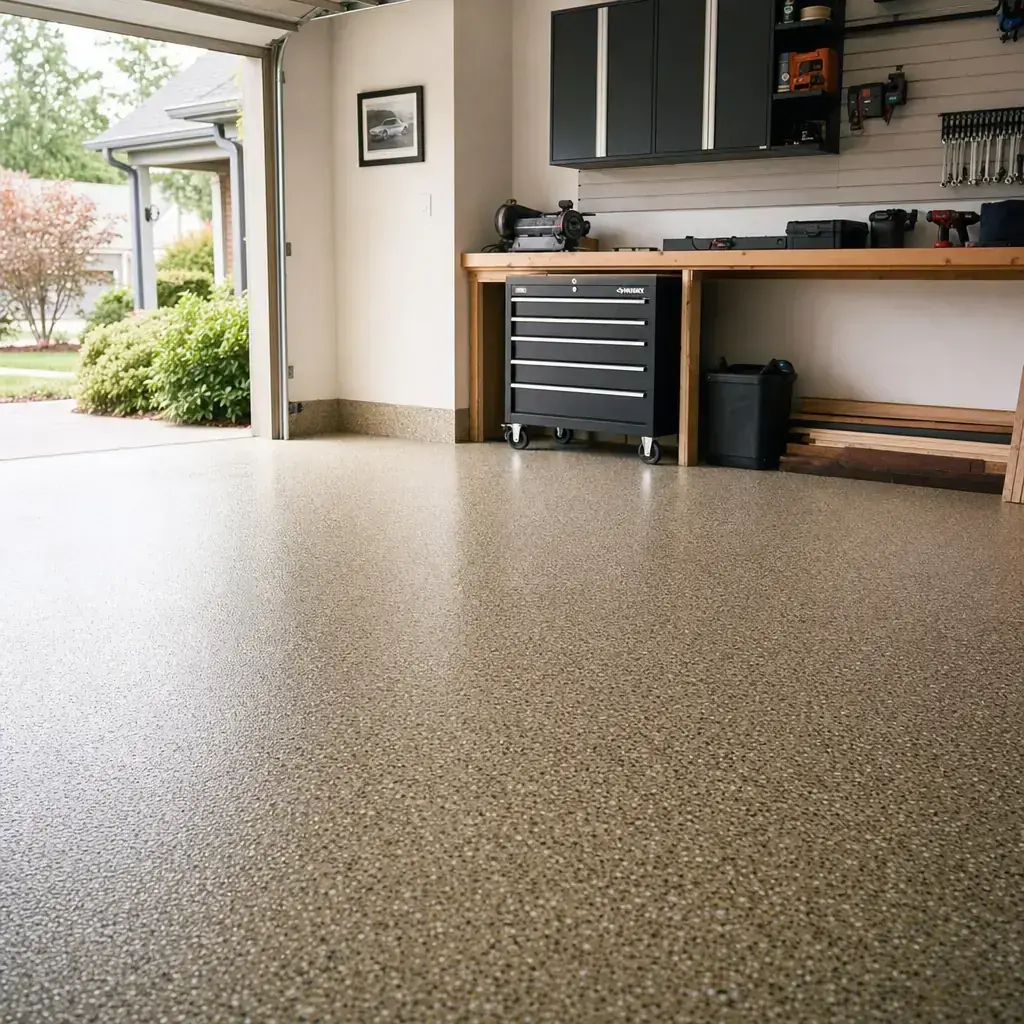
Most coating failures around here are not product failures. They are timing failures, and the reason is the same thing that makes a Gulf Coast August unpleasant to stand in.
What actually stops a coating curing
Epoxy and polyaspartic cure by chemical reaction, and both care how close the air is to condensing on the slab. The working rule is that the concrete has to stay several degrees above the dew point for the whole cure, not just at the moment the first coat goes down. Drop below it and moisture forms in the film. You get a milky haze, soft patches, or a topcoat that never properly hardens.
Why the nights are the problem, not the days
People assume heat is the enemy. It is the overnight low that decides this. At Bush Intercontinental the June, July and August average lows are 73.7, 75.7 and 75.4 degrees (NWS 1991-2020 normals). A slab that never cools far overnight sits close to the air temperature all night, which is exactly when the margin is thinnest and when a slow-curing topcoat is still working.
The months with the most margin
Late autumn through early spring is the easy window. Annual average high is 80.5 and the average low 60.5, so outside the summer block the slab has room to sit well clear of condensing air. That does not make summer impossible. It makes summer something you plan around, usually by starting early and choosing a system that is through its critical stage before the evening.
Rain is the other half of the calendar
51.84 inches a year falls here, and it does not arrive politely. An attached garage is sheltered, but a driveway apron, a patio or an open bay is not, and a slab that took rain two days ago can still be releasing moisture. That is a testing question rather than a guessing one, which is why a tape or calcium chloride test belongs in the quote.
What to ask whoever quotes the job
Ask how they will check the slab on the day, not just at the survey. Ask what happens if conditions are wrong when they arrive. An installer who says the weather makes no difference is telling you they do not measure it. The right answer is unglamorous: they read slab temperature and conditions, and they will move a pour rather than fight one.
Booking it without gambling on the forecast
In practice this means keeping some flexibility in the date and accepting that a rescheduled morning is cheaper than a floor that hazes. If you want the shortest possible window, a polyaspartic system cures in hours instead of days, which takes most of the weather risk out of the job. More on how that works on our polyaspartic coatings page, or on garage floor epoxy if you are weighing the two.